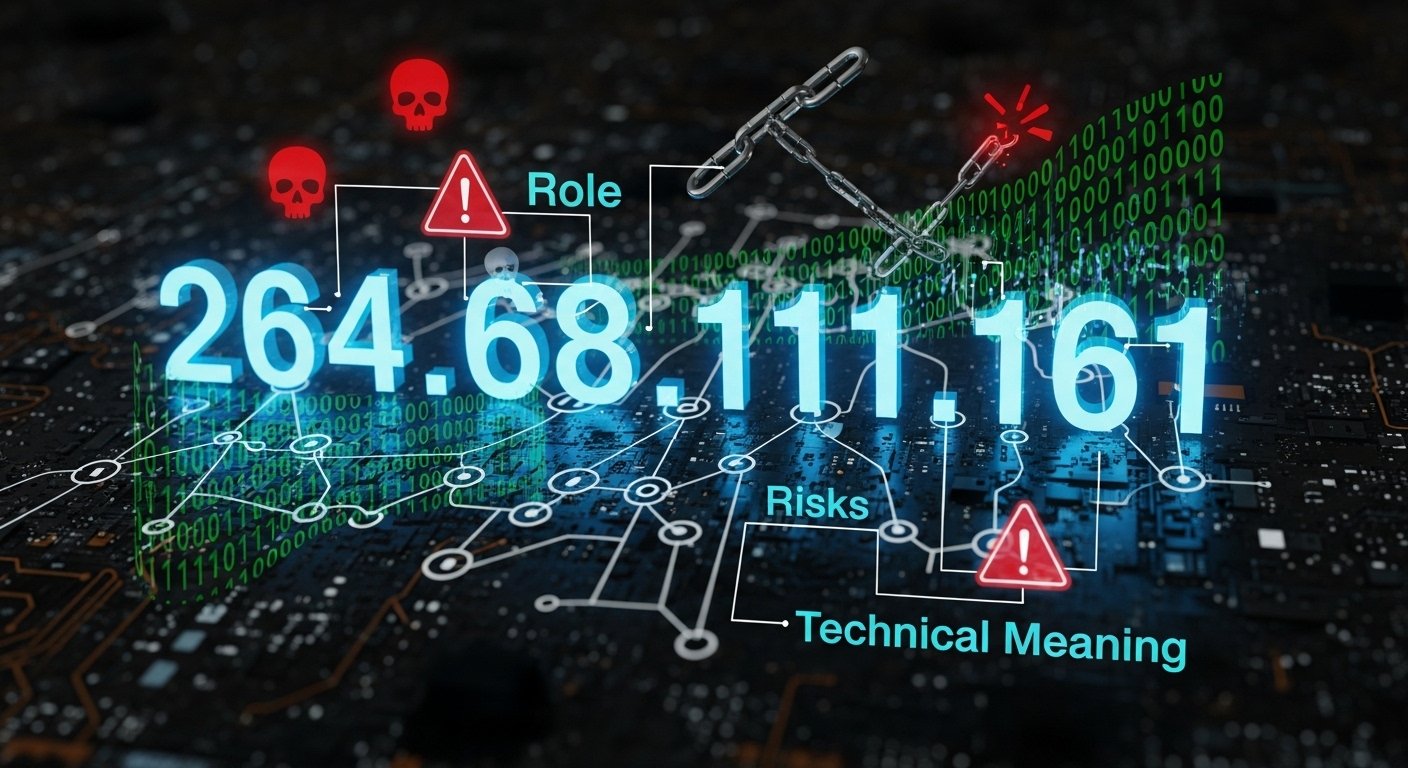
The IP address 264.68.111.161 may look like just a random sequence of numbers, but IP addresses carry important technical meaning in networking, cybersecurity, and internet infrastructure. When users search for 264.68.111.161, they are often trying to understand whether it is valid, where it originates, or why it appears in logs, analytics reports, or firewall alerts. In this article, we will break down what this IP represents, how IP addressing works, and why this specific address deserves closer technical examination.
What Is an IP Address?
An IP (Internet Protocol) address is a unique numerical label assigned to devices connected to a network. It enables devices to communicate with each other over the internet or local networks. IPv4 addresses consist of four octets separated by dots, each ranging from 0 to 255.
At first glance, 264.68.111.161 follows the IPv4 structure because it contains four numeric segments separated by dots. However, structure alone does not guarantee validity. The allowed range for each segment in IPv4 is 0–255. This detail is crucial when evaluating 264.68.111.161.
Is 264.68.111.161 a Valid IPv4 Address?
The short technical answer is no. The first octet in 264.68.111.161 is 264, which exceeds the maximum allowable value of 255 in IPv4 addressing. Therefore, 264.68.111.161 is not a valid public IPv4 address under standard internet protocol rules.
This raises important questions. If 264.68.111.161 appears in a log file, analytics report, or firewall configuration, it could indicate:
- A malformed entry
- A software bug
- Manual data manipulation
- A spoofed or corrupted log
- Testing or placeholder data
Understanding that 264.68.111.161 is technically invalid helps professionals immediately diagnose potential configuration or logging errors.
Why Might 264.68.111.161 Appear in Logs?
Even though 264.68.111.161 is not a legitimate IP address, it can still appear in digital environments. Here are common scenarios where this happens.
1. Software Development and Testing
Developers sometimes use dummy IP addresses for testing applications. Since 264.68.111.161 is outside the valid IPv4 range, it clearly signals that the value is not meant to represent a real-world device. This prevents accidental routing or real traffic interaction.
2. Data Corruption or Input Errors
If a system accepts user-generated input without proper validation, an invalid address like 264.68.111.161 might be stored. In this case, the appearance of 264.68.111.161 highlights a need for better validation rules in the application.
3. Log Manipulation or Spoofing
In cybersecurity investigations, strange IP values like 264.68.111.161 can indicate tampered log files. Attackers sometimes insert malformed entries to confuse tracking efforts or disrupt monitoring systems.
4. Misconfigured Scripts
Automation scripts pulling IP data from databases can sometimes concatenate numbers incorrectly. For example, adding 10 to 254 may result in 264 if no range control exists. When this happens, 264.68.111.161 might appear as a system-generated anomaly.
Technical Breakdown of IPv4 Limits
To understand why 264.68.111.161 fails validation, we need to review how IPv4 works. Each octet in an IPv4 address is represented by 8 bits. The maximum value for 8 bits in decimal is 255. Therefore, any value above 255 is impossible in standard IPv4 formatting.
The valid range is:
0.0.0.0 to 255.255.255.255
Since 264 exceeds 255, 264.68.111.161 breaks the binary structure required for routing on the internet. Routers and networking equipment will reject such an address immediately.
Could 264.68.111.161 Be IPv6?
IPv6 addresses use hexadecimal notation and a completely different format. They do not resemble 264.68.111.161 at all. Therefore, 264.68.111.161 cannot be interpreted as an IPv6 address either. It strictly attempts to mimic IPv4 formatting but violates its numeric constraints.
Security Implications of Invalid IPs
When 264.68.111.161 appears in a system, it should prompt investigation. Invalid IP addresses can indicate deeper issues:
- Weak data validation controls
- Poor firewall configuration
- Flawed log parsing scripts
- Application-level input vulnerabilities
If attackers discover that a system does not validate IP ranges correctly, they may exploit that weakness. Even though 264.68.111.161 itself is harmless due to invalidity, its presence can signal security gaps.
How to Prevent Invalid IP Entries
Organizations can prevent issues related to addresses like 264.68.111.161 by implementing proper safeguards:
Use Strict Input Validation
Always enforce IPv4 range checks (0–255 per octet) before storing or processing IP data.
Apply Regex Filtering
Regular expressions can ensure correct formatting before accepting input.
Monitor Logs for Anomalies
If 264.68.111.161 appears repeatedly, automated monitoring systems should flag it for review.
Strengthen Firewall Rules
Firewalls should automatically reject malformed IP entries without logging unnecessary noise.
Why People Search for 264.68.111.161
Search queries for 264.68.111.161 typically fall into informational categories. Users might encounter this IP in:
- Server access logs
- Suspicious traffic alerts
- Proxy reports
- Analytics dashboards
- Security incident investigations
Because the address looks realistic, it can cause confusion. Understanding that 264.68.111.161 is invalid provides immediate clarity and prevents unnecessary concern.
Real-World Example Scenario
Imagine a website administrator reviewing traffic logs and noticing multiple requests from 264.68.111.161. Instead of assuming an attacker from a specific region, a technical review reveals that the IP cannot exist. This shifts the investigation toward internal logging systems rather than external threats.
Such insight saves time and avoids false assumptions.
Conclusion
The IP address 264.68.111.161 may appear legitimate at first glance, but technical analysis reveals that it is invalid under IPv4 standards. The presence of a number exceeding 255 makes routing impossible and confirms that it cannot represent a real device on the public internet.
However, its appearance in logs or systems should not be ignored. It may indicate testing data, configuration errors, corrupted entries, or validation weaknesses. By understanding the structure of IP addresses and enforcing strict validation rules, organizations can prevent confusion and maintain stronger network integrity.
When evaluating unusual addresses like 264.68.111.161, the key is not panic but verification. A simple range check often provides the answer.